Tactical Asset Allocation (TAA)
Theoretical foundations
Numerous studies show that strategic allocation accounts for most of the variance in returns (~90%), but this does not rule out the possibility that tactical allocation can consistently add value when rigorously managed to exploit short- and medium-term market inefficiencies. To do this, multiple factors must be analyzed.
Macro-economic cycles
The relationship between the economic cycle and the relative performance of asset classes is the cornerstone of any TAA. Broadly speaking, the cycle is divided into four phases—expansion, slowdown, recession, recovery—during which asset classes behave differently.
- During expansion, cyclical equities (industrials, materials) are overweighted, while sovereign bonds and cash are underweighted.
- During a slowdown, rotate towards defensive sectors (utilities, healthcare, consumer staples) and reduce industrial commodities.
- During a recession, overweight investment-grade bonds, gold as a safe haven, and cash.
- During a recovery, gain early exposure to risky assets, commodities, and small caps.
The practical challenge is identifying the turning point in the cycle, which can never be observed in real time without noise. Only leading economic indicators have any predictive power:
- PMI (purchasing managers index) for the manufacturing and services sectors, especially the new orders component (PMI, ISM, IFO, OECD leading indicators)
- durable goods orders
- consumer confidence
- mortgage loans and building permit applications
- changes in credit to individuals and businesses
Markets react mainly to surprises relative to forecasts (follow Citigroup's economic surprise indices for the different regions).
Monetary policy and financial conditions
The level and direction of key interest rates, rather than their absolute level, have a strong influence on relative allocation. Three variables should be monitored continuously:
- The real level of interest rates: negative real rates structurally favor real assets (gold, commodities, real estate) and penalize long-duration bonds.
- The slope of the yield curve (2-10 year spread): an inversion generally signals upcoming stress on risky assets within 12 to 18 months, but its predictive power varies depending on the cycle.
- Overall financial conditions (Goldman Sachs GCI indices, Chicago Fed FCI): these incorporate credit spreads, implied volatility, the dollar, and asset prices to provide a synthetic signal.
Inflation and expected inflation
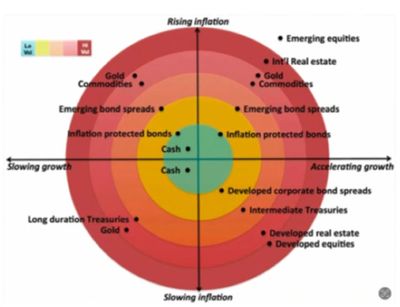
Identifying the inflation regime and anticipated inflation are important for TAA (nominal bonds or TIPS, duration). Historically, commodities have performed well during unexpected inflationary surprises. Unfortunately, their volatility makes them a difficult hedging instrument to use.